
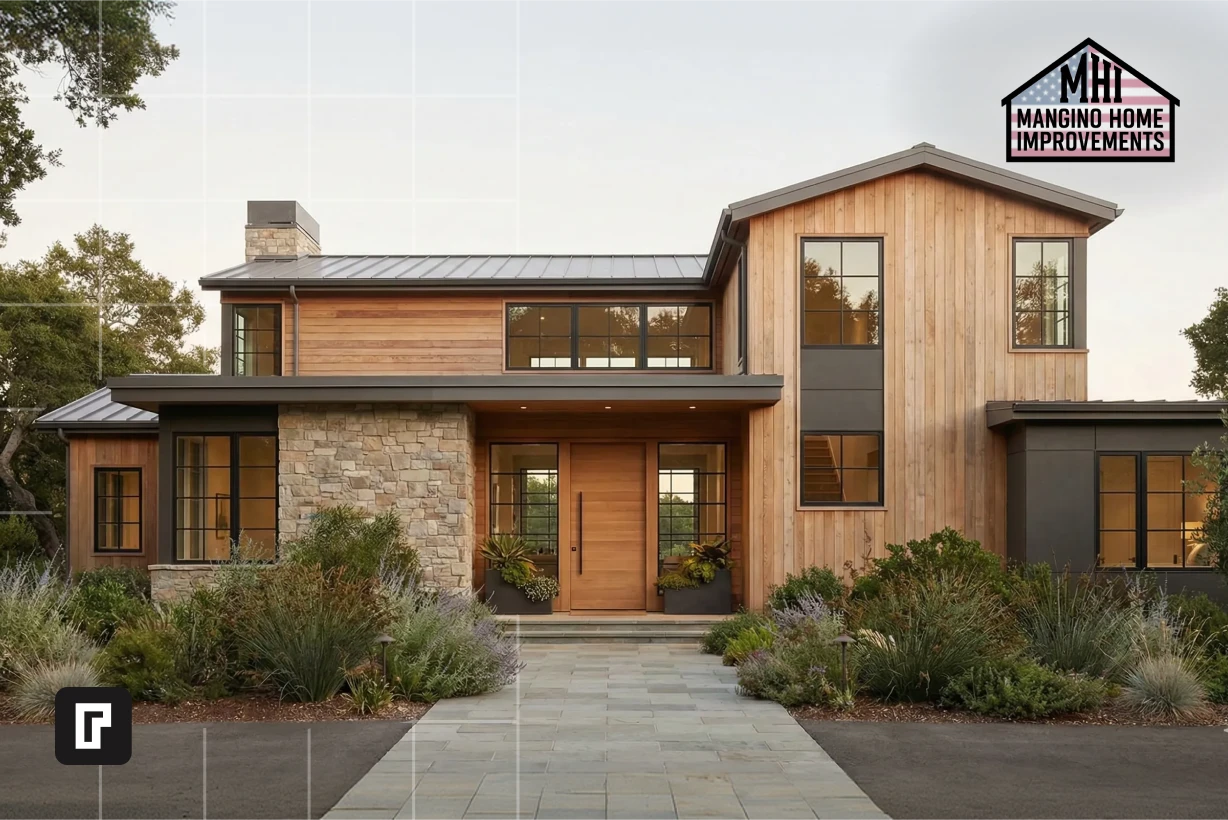
Mangino Home Improvements started as a local handyman operation in Orchard Park, New York. After adopting Bolster into their tech stack, they quickly were able to grow and scale into much larger projects - finally estimating and bidding on custom homes in late 2025.
Handyman - Remodeling - General Contractors - Custom Home Building
11-50
Scaling from handyman, general contracting, remodeling and then into custom home building. Reducing estimating time from 8 hours to 30 mins (93.75% reduction)

Mangino Home Improvements began as a local handyman operation in Orchard Park, New York—quick fixes and fast quotes. In that phase, a one-page PDF was enough to win jobs and run the business.
Sharing the story of our journey from a small handyman service to a full-scale remodeling business helps illustrate our growth, build credibility, and connect with clients through real-world examples.
As the brothers took over the business, they started acting more like general contractors than “fix-it” techs—and speaking like general contractors. Their plan was to grow into bathroom and kitchen remodeling, then become a builder—a custom home builder—with repeatable systems.
“We started out on a PDF document… one page, maybe 2 pages at most.”
Once projects hit $80,000–$100,000, the old quoting template became a problem. A vague scope like “build addition” didn’t provide the visibility clients expect and left room for confusion on what was covered.
“If you just say, ‘I’m going to build you an addition for $100,000’… I’d be like, ‘OK… what’s included in that?’”
That lack of clarity created risk: missed line items, overlooked walls, and change requests that could blow up cost and trust on a large home project.
Caylor made a clear decision: rebuild estimating so every project could be priced with real quantities and consistent logic. He pulled his Excel habits into Bolster, turning spreadsheets into construction estimating tools the team could handle daily.
Instead of starting from scratch each time, he could find a template, input square footage and key measurements, and create a complete bid quickly, with support notes attached.
“To transfer that into Bolster, it’s literally the exact same thing.”
The heart of the process was translating field detail into structured estimating blocks. A bathroom assembly didn’t just say “tile”—it included backer board, fasteners, grout, waterproofing, and labor, spelled out as a point-by-point scope.
“Now with Bolster… a simple bathroom turns into 6–7 pages… and it shows mortar, grout, tile, drywall… I put screws in there.”
That structure gave homeowners a clearer point of comparison when reviewing options. It also gave the team better grip on margins and helped protect profits when scope shifted mid-project.
Before the shift, notes, photos, and supplier pricing lived in an email inbox, making it hard to manage handoffs. With stronger project planning, the team kept selections, products, and assumptions in one place, which reduced rework and made internal support easier.
It also helped leadership: with an open checklist, the owners could stop chasing details across messages and make faster decisions about staffing.
“The pipeline for me… literally every morning… that’s my go-to board… it helped me keep track of all my jobs.”
As they moved deeper into remodeling, Mangino leaned into design clarity. They had to learn to present design tiers, list products by finish, and show what’s included—right down to paint prep and the final paint coats—for inspiration.
Even on a small home refresh, that approach made upgrades visible early, so clients could decide with confidence.
“They’re not stuck with this specific fixture… they can see all different types and they can see the price… it eliminates the back and forth.”
When Mangino began presenting itemized proposals, homeowners responded immediately. A bathroom scope could become six or seven pages, and the team heard the same reaction: “Wow, you’re really detailed.”
That detail helped homeowners compare contractors, understand services, and approve upgrades—like heated floors—without feeling sold to.
“I’ve had customers… say, ‘Yes, you’re a little bit more expensive, but we went with you because your estimate was so professional.’”
Time was the constant constraint. If Caylor wasn’t in the field, he wasn’t making money; if he wasn’t at the desk, the pipeline stalled. The new system changed that balance for the business.
With assemblies in place, estimating moved from long nights to a focused block of work. The team could run multiple quotes in the same window, keep scheduling on track, and still show key detail on each project.
“Bolster has… cut [estimating] down to almost nothing… I can pump out four or five estimates… and now I can go home at 4:00.”
Scaling wasn’t treated as a sprint. The leadership team avoided the trap to chase every lead, and instead built a plan: standardize templates, hire selectively, and only add capacity when the process stayed stable.
That mindset matters for general contractors who want to move from handyman services into larger home remodeling and new home construction—scaling with control instead of chaos.
“Do you think you could have achieved scaling your business to this size without Bolster?… No. Simple answer: no.”
For general contractors looking to grow from small jobs to major remodeling and custom home projects, a strong marketing strategy is just as important as a solid project plan. In today’s construction landscape, your business needs more than word-of-mouth to stand out—you need visibility, credibility, and a clear message that shows clients why you’re the right contractor for their home.
Start with your online presence. A professional website that highlights your services, showcases floor plans, and features completed projects can make a powerful first impression. Social media platforms are another essential tool, helping you share project news, design inspiration, and updates on the latest trends in construction. By posting before-and-after photos of kitchen remodels or sharing insights on new cooling systems, you keep your business top-of-mind for potential clients.
Don’t overlook the value of industry connections. Building relationships with other contractors, suppliers, and architects can lead to referrals and collaborative opportunities. Joining organizations like the National Association of Home Builders not only boosts your credibility but also keeps you informed about changes in square footage standards, new equipment, and best practices in project planning.
Modern tools can give your marketing efforts a real edge. Estimating software and project management platforms help you create detailed, accurate bids—showing clients you’re organized and in control of every detail. Online directories and review sites, such as HomeAdvisor or Angie’s List, increase your visibility and help new clients find your services when they’re ready to hire.
Staying current with construction news and industry trends is key to keeping your business competitive. Whether it’s learning about sustainable building practices, the latest in home design, or new scheduling tools, ongoing education helps you offer the best options to your clients. Attending events like the International Builders’ Show or the National Association of Home Builders Conference can provide inspiration, networking, and firsthand knowledge of what’s next in the industry.
Ultimately, marketing for general contractors is about more than just advertising—it’s about building trust, demonstrating expertise, and supporting clients through every step of the remodeling or construction process. By investing time in your marketing plan, leveraging the right tools, and staying connected to industry trends, you set your business up to grow—whether you’re tackling a small kitchen update or managing a custom home build.
Caylor watched construction news and broader trends as expectations keep increasing. In june, suppliers pushed new finish products; in july, demand spiked for mid-range remodeling; and in late july, clients asked for clearer options.
By october, contractors tightened bid policies; in late october, lead times shifted; and by nov, homeowners wanted documentation—especially in nov. In nov, delays at a competitor became local news; and in late nov, lead times shifted again—proof trends can change year to year.
In december, and again in mid december, the team updated templates for construction. In march, they refined intake; in april and late april, they added a new kitchen assembly plus a cooling upgrade; in august, they adjusted pricing; and in september, they trained a new estimator.
As estimates improved, the back office improved. Better scope detail reduced disputes, and more accurate invoices were easier to issue and reconcile—less time lost, better cost tracking.
On larger builds, the team accounted for equipment rentals and specialty tools, and every line item had an owner.
“I do all my invoicing through Bolster… I love seeing ‘you got paid’… I didn’t really have to do anything.”
By rebuilding their estimating engine, Mangino moved from handyman quotes to professional proposals that matched premium remodeling expectations. They improved the experience at every home visit, created cleaner handoffs, and gained confidence to bid a custom home build—work they were honored to be trusted with.
“Now my time is almost next to nothing… I’m just pulling it in, putting a couple measurements… and it spits out a price.”
The biggest change was simple: the business chose to build a repeatable system. That system supported thousands of decisions over time, so the team could grow into the future without losing control.
For general contractors trying to move from small repairs into higher-value construction jobs, treat estimating as a product. Open your template library, add checklists that reflect real work, and keep refining the process as you scale.
Do that, and you don’t just win a project—you build a business that’s ready for the next step.
“If you truly want to win bids… and you want to look professional before you even walk in the door… Bolster’s the way to do it.”
Hear from other contractors who have experienced success using Bolster.




"If you're willing to invest in your business and work with Bolster, you're going to exceed your expectations of what you can achieve. If you put in the work, you'll see a return on investment quickly."


