
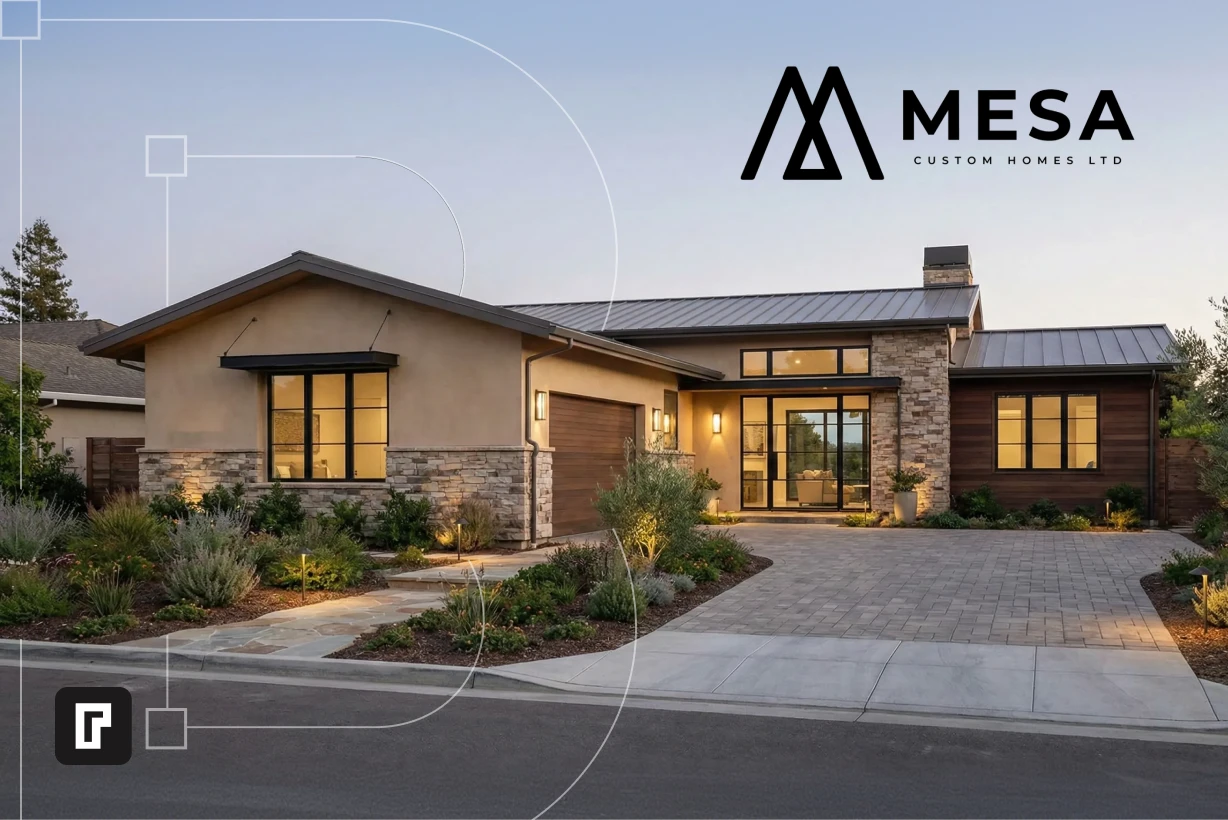

Mesa Custom Homes was born out of a third-generation builder Jason, and operates out of Vancouver, BC. Jason's reputation is rooted in trust, craftsmanship and community relationships, and those only seem to get stronger as a result of a completely custom experience with clients, where the Bolster software has excelled in assisting with.
Custom Home Builders
1-10
Estimating 5x faster (80% faster), getting paid twice as fast, improving job win rate by 100%, improving client experience and trust

Jason Ratzlaff is a third-generation builder and the owner of Mesa Custom Homes. His company specializes in building high-quality custom homes for families who want more than just a new home. They want a space that reflects their lifestyle, supports their day-to-day life, and becomes part of their long-term story.
“We’re building people’s houses. This is their biggest life purchase for most people. So I take that pretty seriously.”
Like many custom homes builders across the country, Jason’s reputation is rooted in trust, craftsmanship, and community relationships. His work spans growing markets, including Tennessee Texas regions where demand for single family homes and custom construction continues to rise. There is also growing interest among custom homes builders in adopting modern construction estimating software to meet rising demand and improve efficiency.
But behind the scenes, the work required to produce accurate estimates was slowing his business down.
Estimating is foundational in construction. It determines project costs, sets expectations, and directly affects profitability. For Jason, estimating had always been accurate, but it was rarely efficient.
Each new project triggered a long estimation process. Plans arrived. Quantities had to be reviewed. Materials, labor costs, and equipment needs had to be identified. Every trade required outreach, follow-up, and clarification.
The work was precise, but it consumed less time only in theory. In practice, it took days.
“The question depends on the home we’re pricing… we’re building houses anywhere from 2,500 square feet to 12,000 square feet right now.”
Before adopting construction estimating software, Jason relied on spreadsheets, email threads, and manual tracking. This approach is still common among construction professionals, especially those building custom homes.
“The ultimate process… our old way was just an Excel sheet… it’s just not very descript for your client.”
Every estimate started from scratch. Even when projects were similar, there was no easy way to reuse data. Quantity takeoff lived in separate files. Costs were updated manually. Changes introduced risk. Manual methods also lacked integrated services such as plan uploads and automated quantity takeoff, which limited both efficiency and accuracy.
For a standard new home, the estimating work often took a full week. Larger custom projects required even more time.
“Generally speaking… you would spend almost a week—full week—putting a full house budget together… or maybe even more depending on the size of the job.”
Time was the first pain point Jason needed to solve.
Spending so much time estimating meant less time spent with customers, less time refining designs, and less time managing active construction. It also limited how many projects his business could pursue.
Saving time became a business priority, not just a convenience.
“It also saves us a lot of time too on our end. It’s a lot uploading it all on the front end… But once you’re ready to start pricing houses with this… it saves it… a decent amount of time…”
Despite the time burden, Jason refused to sacrifice accuracy. Accurate estimates were essential to protecting margins, maintaining trust, and delivering on promises made to families.
However, maintaining accuracy through manual processes required constant checking. Errors were always a risk. Small mistakes in quantities or cost assumptions could cascade through an entire budget.
Reducing errors without losing accuracy became the real challenge.
“I would way rather tell someone their house is going to cost more than they can afford and be upfront and honest than lie to them… and then you get halfway through and you’re over budget and no one’s happy.”
The deeper issue was structure. Jason’s estimation process depended heavily on memory, experience, and informal systems.
There was no centralized, customizable database. Data lived in emails, spreadsheets, and people’s heads. Lessons learned on one project were not systematically applied to the next.
As the construction market evolved, this approach became harder to sustain.
Jason began searching for an estimating solution that matched the realities of custom construction.
He needed estimating software that could support complex scopes, variable designs, and evolving client decisions. He needed an all in one solution that combined estimating, takeoff, quantities, and data into a single platform.
Most importantly, he needed a tool that respected how builders actually work.
After evaluating options, Jason selected a construction estimating software platform designed for custom homes builders and general contractors.
The platform offered customizable templates, a customizable database, strong takeoff capabilities, and a workflow that supported real construction processes instead of forcing rigid assumptions.
It also offered excellent customer support, which mattered as Jason planned a major shift in how he estimated projects.
The first step was not software configuration. It was data.
Jason committed to building a data driven estimating system grounded in real trade knowledge. He spent weeks sitting down with subcontractors to understand how they price work.
Plumbers, electricians, framers, cabinetmakers, and other trades walked through their logic. They discussed materials, labor costs, equipment usage, and installation assumptions.
This data became the foundation of Jason’s new estimation process.
“That was a lot of pre-work before that… him and I sitting down for probably two hours going over how to price every… cabinet and then me inputting that into the program… I probably got a full month of inputting information…”
Instead of requesting a new bid package for every project, Jason documented pricing rules and quantities once.
These rules were entered into the software as assemblies and components. Each assembly reflected real-world construction logic, not generic averages.
This approach reduced guesswork and improved accuracy across projects.
One moment confirmed that the system worked.
Jason built a full cabinet scope inside the estimating software using his data and quantities. He did not request a quote upfront. Instead, he asked the cabinetmaker to independently price the same scope.
On a $200,000 cabinet project, the difference was only a few hundred dollars.
That result validated the accuracy of the data driven estimating approach.
“It was a $200,000 cabinet job… we were $500 apart. So that tells me I can confidently price without even talking to him…”
Initially, Jason experimented with lump-sum allowances. It quickly became clear that this structure created problems.
Lumped costs made it harder to adjust quantities and harder to explain budgets to customers.
Jason restructured his estimates to mirror real construction components. Fireplaces, exterior features, interior elements, and foundation components were separated into clear line items.
“I had it all kind of lumped, but now I have everything separated… master bedroom fireplace, your flex room fireplace, your living room fireplace, your exterior post…”
This structure improved quantity takeoff accuracy and flexibility.
When a client changed a design element, Jason could update specific quantities instead of reworking the entire budget. Linear takeoff could be applied where appropriate, improving speed and consistency.
This reduced errors and saved time throughout the project.
Finish selections are a major source of cost variation in custom homes.
To address this, Jason created tiered options for selection-heavy scopes such as plumbing fixtures and hardware. Each tier represented a realistic level of finish.
“I’ve categorized… with three tiers, silver, gold and platinum.”
This approach improved decision making for families building their dream home.
Instead of abstract allowances, customers could see what different levels meant for cost, materials, and lifestyle.
This clarity led to more accurate estimates and fewer surprises later in the project.
Accuracy depends on shared understanding.
Jason added images and detailed descriptions to nearly every line item. Materials, construction methods, and finishes were clearly documented.
This reduced misunderstandings, minimized errors, and strengthened trust between builder and customers.
“Are these pictures close to what you’re envisioning? If yes, then we’re good. If not… we can shave that down… or if we didn’t give you enough…”
Once the upfront work was complete, Jason began to see real speed gains.
With customizable templates and assemblies in place, he no longer rebuilt estimates from scratch. For a new project, he duplicated a template, adjusted quantities, and reviewed key scopes.
This reduced errors and saved time throughout What once took a week now took one to two days.the project.
“I could do a standard size house now… probably like two days, one day, two days.”
This reduced errors and savedSaving time did not come from shortcuts. It came from structure.time throughout the project.
The software handled repetitive work. Data ensured accuracy. Jason’s experience provided oversight.
The result was more accurate estimates completed in less time.
“The reason we did this wasn’t necessarily like go faster… the big draw for us was… the client friendliness… and sellability… And now that I’m into it, it’s like, okay, this is actually helping us on the timeline too…”
Jason’s work spans multiple cities and markets, including Tennessee Texas regions where construction demand continues to grow.
The platform allows cost data to be adjusted based on city, market conditions, and material pricing.
This flexibility supports sustainable business growth.
Collaboration between custom home builders and general contractors is at the heart of successful construction projects. In today’s fast-paced construction industry, ensuring estimate accuracy is not just a best practice—it’s a necessity for delivering projects on time, within budget, and to the highest standards. Construction estimating software has become an essential tool for general contractors, empowering them to create accurate estimates, streamline the estimation process, and make data-driven decisions that benefit every stakeholder.
Modern estimating software brings the power of a customizable database to the fingertips of general contractors. By leveraging historical data and real-time market information, contractors can account for all the materials, labor costs, and equipment required for each unique project. This data-driven estimating approach eliminates guesswork, reduces errors, and ensures that every estimate reflects the true scope and complexity of the work.
One standout feature is linear takeoff, which allows general contractors to quickly and precisely quantify materials for single family homes and larger developments alike. With linear takeoff, estimating the exact amount of lumber, drywall, or piping becomes a matter of minutes rather than hours, significantly reducing the risk of costly errors and saving valuable time.
Beyond takeoff, construction estimating software offers a suite of tools designed to support the entire estimation process. Customizable templates and bid package management enable contractors to tailor each estimate to the specific needs of the project, whether it’s a dream home or a commercial build. The all-in-one solution integrates estimating, bid management, and project oversight into a single platform, improving communication and workflow efficiency across teams.
Excellent customer support ensures that general contractors can fully leverage these features, adapting the software to fit their business and market—whether they’re working in Tennessee, Texas, or any other booming region. This support, combined with robust bid management tools, helps contractors present clear, professional proposals that inspire confidence and facilitate better decision making for clients.
Ultimately, accurate estimates are the foundation of every successful construction project. By adopting construction estimating software, general contractors can deliver more accurate estimates, reduce errors, and manage project costs with greater confidence. The result is a smoother estimation process, stronger client relationships, and the ability to take on more projects—turning every build into a true reflection of the client’s vision and the contractor’s expertise.
The new system also improved bid management.
Clear estimates made proposals easier to present and easier for customers to understand. This improved confidence and increased conversion rates.
The estimation process became part of a stronger sales workflow.
Integration with other tools reduced manual entry and supported a smoother workflow.
Data flowed through the platform, supporting purchasing, planning, and project management.
This improved efficiency across the business.
The benefits extended beyond estimating.
Jason gained better access to data, improved search across estimates, and clearer insight into quantities and cost trends.
These benefits supported better decision making across projects.
Excellent customer support played a key role.
Ongoing support helped Jason refine templates, adjust workflows, and fully leverage platform features.
This partnership ensured long-term success.
“Alex has been 10 out of 10, 11 out of 10, fantastic… extremely supportive… really good at explaining how to do things…”
With less time spent estimating, Jason could pursue more projects.
He spent more time with customers, more time refining designs, and more time contributing to his community.
This strengthened relationships and supported growth.
Every project represents a dream.
Accurate estimates ensure budgets align with expectations and support a positive building experience.
Families receive transparency, clarity, and confidence.
Jason’s estimation process is now scalable.
Templates, data, and structured workflows allow the business to grow without increasing administrative burden.
Accuracy remains consistent as volume increases.
The software acts as a tool, not a replacement.
Jason’s experience remains central. The platform enhances speed, accuracy, and confidence.
This balance is critical for custom homes builders.
Structured data and repeatable processes reduce errors.
Each project benefits from lessons learned on previous builds.
Accuracy improves over time.
Access to historical data supports better planning and forecasting.
Jason can analyze costs, materials, and labor patterns to improve future estimates.
This insight strengthens the business foundation.
Jason’s story reflects a broader shift in construction. Modern estimating software enables builders to work efficiently, accurately, and confidently.
This approach benefits builders, customers, and the industry as a whole.
Jason did not become faster by cutting corners. He became faster by investing in data, process, and the right estimating solution.
“You’ll get what you put in… It’s not going to be like something that you can just purchase the software and life is going to change. You have to be willing to put the time in.”
The result is accurate estimates, reduced errors, saving time, and a stronger business positioned for long-term growth in the construction industry.
Hear from other contractors who have experienced success using Bolster.





"If you're willing to invest in your business and work with Bolster, you're going to exceed your expectations of what you can achieve. If you put in the work, you'll see a return on investment quickly."


