
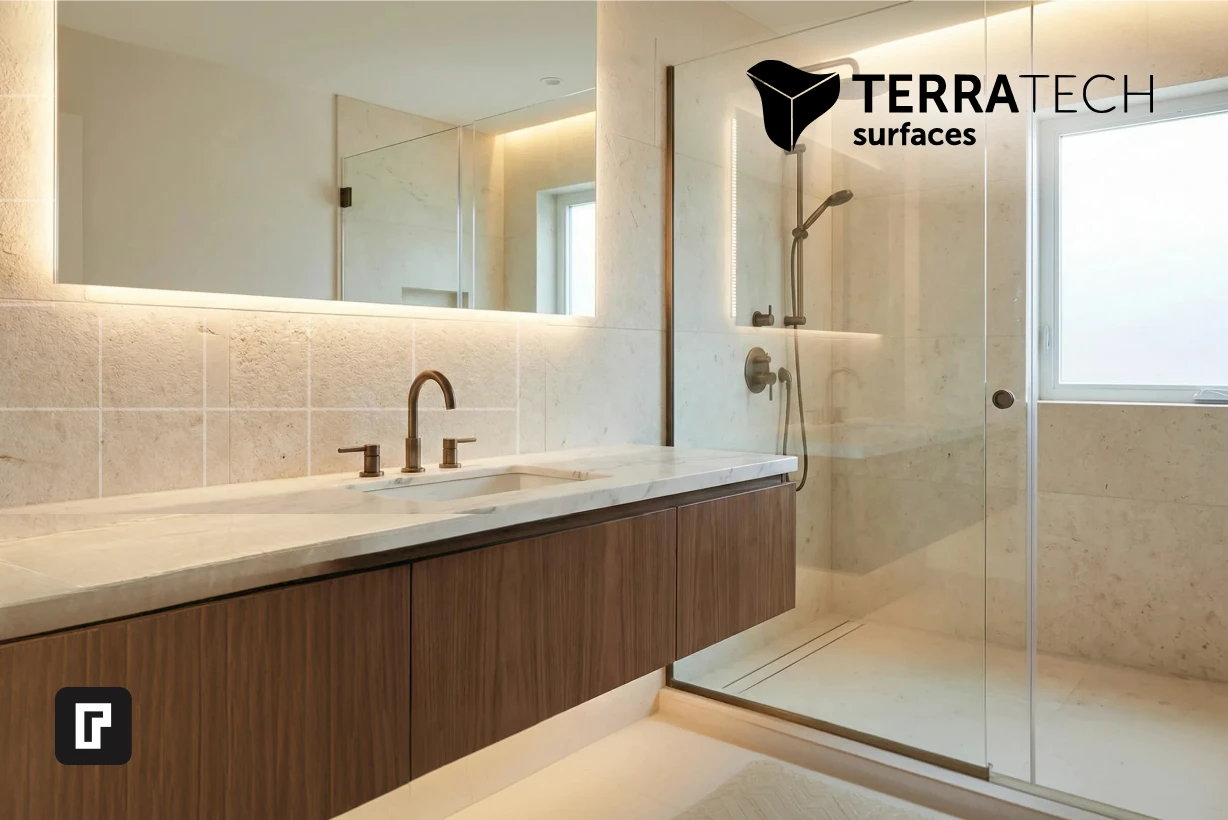

TerraTech delivers premium surface solutions crafted to elevate every space - indoors or out. Powered by Venux, collections are rooted in natural beauty and engineered for lasting performance.
Remodeling - Bathrooms
11-50
Saving time, winning more jobs

Terra Tech Surfaces is a Minnesota-based company specializing in premium bathroom renovations, especially sintered stone wall panels and solid surface pans. Their work is high-end, repeatable, and in demand—but for such premium projects, using a premium product in the form of advanced bathroom remodeling design software is essential to maintain quality and efficiency. For a long time, however, their estimating workflow didn’t match how efficiently they built in the field.
As the business grew, the team realized their biggest constraint wasn’t craftsmanship or lead flow. It was the time and friction involved in creating estimates fast enough to keep prospects engaged. Evaluating different design software options became crucial to ensure the chosen solution matched the company’s standards and streamlined their workflow.
Before upgrading their process, a standard bathroom quote often took one to two hours. That time didn’t come from neatly scheduled office blocks—it came from evenings, weekends, or the rare quiet moment between installs.
In the construction industry, the estimate is often a client’s first real test of professionalism. If the quote arrives late, the customer assumes the rest of the construction process will be late too. Even if that’s not true, perception shapes decisions.
Terra Tech could see the pattern clearly: slower estimates meant slower follow-ups, and slower follow-ups meant lost work.
This wasn’t simply about being busy. It was about momentum.
Homeowners don’t request a quote casually. When someone is excited about a new bathroom, they’re comparing design options, imagining finishes, and thinking about budget. That excitement is an asset—until it fades.
If an estimate shows up days later, the dream bathroom becomes less urgent. Another contractor responds faster. The customer starts second-guessing the plan. Even great builders lose jobs in that gap.
Terra Tech didn’t want to win through pressure or discounts. They wanted to win because their process helped customers make confident, informed decisions quickly. Choosing an excellent choice of bathroom remodeling software can be a key factor in maintaining client excitement and streamlining the decision-making process.
Slow estimating wasn’t just delaying revenue. It was quietly draining energy across the business.
When estimates pile up, they steal attention from production. When production gets busy, estimates get pushed. The result is a loop where the team is always catching up, and the business can’t reliably take on more projects without adding stress.
Terra Tech didn’t need a motivational fix. They needed a system-level fix that made estimating feel repeatable, fast, and accurate.
Terra Tech’s fieldwork had patterns. Their shower systems repeated. Their materials were consistent. Their vendor combinations were familiar. Even many bathroom layouts shared similar dimensions and construction requirements.
But their estimating workflow treated every job like a custom invention. Even when a floor plan looked similar, the process still forced the team to rebuild the estimate from scratch.
That mismatch between repeatable work and non-repeatable estimating was the root of the time problem. Effective bathroom remodeling software should be flexible enough to accommodate specific project requirements, ensuring both efficiency and customization.
Traditional takeoff tools are built to measure and list. They’re useful for capturing quantities, but they don’t naturally help contractors turn “the way we build” into reusable structure.
For Terra Tech, that meant every quote required rethinking scope, re-entering line items, rechecking labor costs, rechecking material costs, and rebuilding pricing logic the team had already solved many times before.
On paper, it looked like the team was doing careful work. In reality, they were repeating the same mental labor over and over.
The slow estimate problem got worse when customers wanted options.
In bathroom remodeling, choices matter. Matte versus polished finishes. Color changes. Different pan sizes. Slight upgrades that shift pricing but don’t change the core install.
Yet in the old workflow, those option requests triggered rework. A client wanting to see the same bathroom in a different finish often meant Eric had to rebuild and resend a new quote.
The quote didn’t support exploration. It forced the team to act as a manual “option generator,” and each new request restarted the clock. Modern bathroom remodeling software excels by allowing users to quickly visualize and adjust design options, streamlining the revision process.
Terra Tech noticed something painful: they didn’t always lose because they were the wrong contractor.
They lost because they didn’t respond fast enough to stay top of mind. A couple days of delay could be the difference between a signed project and a silent lead.
And because bathroom projects can be emotionally driven—people want comfort, beauty, and a sense of progress—momentum matters. When the excitement is high, customers move. When excitement fades, they pause, shop, or disappear.
Terra Tech wasn’t willing to trade accuracy for speed.
They needed accurate estimates that reflected real project costs. They needed clear estimates that clients could understand and compare. And they needed detailed estimates that still felt professional instead of overwhelming.
They wanted a system that made precise estimates easier—not a system that merely looked modern.
Terra Tech adopted construction estimating software to stop rebuilding estimates and start building a repeatable system.
The goal was simple: turn their best-known work into structured templates and assemblies so the team could easily create estimates that stayed consistent, accurate, and fast.
This wasn’t about adding advanced features for the sake of it. It was about solving a workflow constraint that was limiting growth.
Bathrooms are small spaces packed with decisions. Optimizing the use of space is critical—design software helps visualize and plan bathroom layouts to maximize both functionality and aesthetics. A few choices can swing budget dramatically. A single finish upgrade can alter material costs. A layout detail can shift labor costs. A selection change can create downstream change orders if it’s not clarified early.
That’s why bathroom remodeling software needs to support both structure and flexibility. The customer wants to explore design options, but the contractor still needs pricing discipline and scope clarity.
Terra Tech wanted a workflow that let customers explore without forcing the team to re-quote from scratch.
Terra Tech set a clear target: standard bathroom estimates in about 15 minutes.
Not rough pricing. Not a vague range. A complete estimate that was clean, professional, and accurate enough to drive a decision.
To get there, they needed to solve three problems: eliminate “from scratch” estimating, stop revisions from forcing rework, and remove the backlog created by busy install schedules.
Terra Tech didn’t overhaul everything overnight.
They started with what they already understood deeply: their core shower systems, the vendors they trusted, and the pricing structure they used repeatedly. They focused on turning repeatable knowledge into reusable cost data.
That was the first major shift—moving pricing out of someone’s head and into a system that could be used consistently.
As they built out their estimating process, the team captured cost data that matched how they actually worked.
Instead of loosely remembered pricing or inconsistent line items, they created structured assemblies that included labor and materials together. This made estimating faster because it reduced decisions and reduced re-entry.
It also made estimating more consistent because the same data powered every similar estimate.
The key foundation was reusable assemblies that mirrored real installs.
Rather than creating a long list of parts for every quote, Terra Tech built assemblies representing their shower systems and typical scope. Each assembly contained material costs, labor costs, and the structure that reflected their real-world workflow.
That made scope clearer and made pricing less fragile.
When the estimate is built the same way the work is built, it becomes easier to defend and easier to improve.
Once assemblies were in place, the quality of the estimate changed.
Instead of a confusing spreadsheet-style output, Terra Tech could send clear estimates that helped customers understand what they were paying for. The estimate didn’t just give a total—it supported confidence.
That clarity helped customers compare options without feeling overwhelmed.
As Terra Tech reused assemblies across projects, they started benefiting from consistency.
Using the same data reduced the likelihood of forgotten items, duplicated line items, or mismatched pricing. The estimate became less dependent on memory and more dependent on structure.
That reduced errors and made the estimating process feel calm instead of frantic.
The next breakthrough was solving the revision spiral.
Terra Tech built selectors and variations so finishes and options could change inside the quote without forcing a full rebuild. Instead of generating a new estimate every time a customer wanted a different finish, the system could present options in a structured way.
That allowed customers to explore and compare choices without waiting on another email.
It also reduced the time cost of small changes, which used to be a major source of delay.
Bathroom design isn’t just about aesthetics—it’s a pricing conversation.
When customers can see how different finishes and selections affect budget, it becomes easier to make informed decisions. Instead of guessing whether an upgrade is worth it, they can see the cost impact clearly.
That keeps the dream bathroom experience alive while keeping the estimate grounded in reality.
Eric described early setup as challenging. Building selectors and variations took effort, and at first it felt like a steep learning curve.
But the team reframed it: this wasn’t busywork. This was building a library.
Each selector created once could be reused across many future quotes. Over time, the system got easier to expand, and the effort began paying back repeatedly.
A system only works if people actually use it.
A user friendly interface and intuitive interface made it easier to build the library without disrupting install work. A drag and drop interface helped reduce friction when organizing assemblies and options.
Instead of feeling like tech work, the setup began to feel like extending the business’s pricing playbook.
Once assemblies and options existed, Terra Tech made duplication standard.
They used their pipeline to reference past estimates, duplicate a similar project, and adjust quantities or scope. Instead of recreating the same estimate structure, the team started from a proven base and tweaked what mattered.
That changed estimating from invention to adaptation.
This is where the biggest shift happened.
With assemblies, selectors, and duplication in place, Terra Tech could easily create estimates for common bathrooms in minutes. They were no longer stuck rebuilding every time, and they were no longer punished by small change requests.
Estimating became a repeatable process instead of a recurring obstacle.
The biggest change was saving time.
A quote that used to demand a long, uninterrupted block could now be built in short windows, which meant fewer late nights and fewer quotes sitting untouched for days.
That time saving effect also reduced mental load. Estimates stopped being the task that lingered in the background and created stress.
For standard bathroom projects, Terra Tech cut estimate time from one to two hours to around 15 minutes.
That shift meant more same-day responses, more active follow-up, and fewer leads going cold while the team was busy installing.
For construction businesses, adopting construction estimating software isn’t just about speeding up the process—it’s about making every project more predictable and profitable. The real value comes from measuring the impact, and that’s where key performance indicators (KPIs) come into play.
Tracking KPIs like estimate accuracy, project costs, and labor costs gives contractors a clear view of how well their estimating software is working. Accurate estimates mean fewer surprises down the line, while real-time visibility into project costs helps teams manage costs and stay within budget. By monitoring these metrics, contractors can spot trends, identify areas for improvement, and make informed decisions that drive better outcomes.
Modern estimating software enables users to easily create detailed estimates with a user friendly interface, reducing the risk of errors and saving time. Advanced features like real-time cost tracking, drag and drop assemblies, and collaborative tools allow multiple users to work together seamlessly, ensuring everyone is working from the same data. This holistic view of the construction process gives contractors greater clarity on project scope, material costs, and labor requirements—making it easier to manage costs and deliver projects on budget.
The benefits go beyond just numbers. With the right construction estimating software, contractors can improve accuracy, reduce costly mistakes, and respond faster to client needs. The software allows for continuous improvement by highlighting which parts of the process are working and where adjustments are needed. For construction businesses looking to grow, these insights are a game changer—enabling them to take on more projects with confidence and control.
Ultimately, measuring KPIs with advanced estimating software transforms the way contractors plan, price, and deliver work. It’s not just about creating estimates; it’s about building a smarter, more resilient business that’s ready for whatever comes next.
Time saved became capacity.
Instead of limiting growth because estimating was too slow, Terra Tech could send more quotes without sacrificing install quality. The business added throughput without adding burnout.
That’s what scaling should feel like: more output, not more chaos.
Structured estimates also improved internal control.
When project costs are visible earlier, the team can make better decisions before committing. That matters for scheduling, planning, and protecting margin.
It also supports better job costing because the estimate becomes a meaningful baseline rather than a loose guess.
Job costing improves when the estimate mirrors the job.
Because Terra Tech’s estimating structure reflected real work, it became easier to manage costs, understand where variations occur, and see the relationship between scope, pricing, and actual outcomes.
That alignment makes cost tracking more useful and less painful.
Even when accounting software lives elsewhere, structured estimates create cleaner inputs for accounting.
Instead of scattered line items across other software, Terra Tech could treat the estimate as a reliable reference. That improved clarity for internal review and made it easier to connect estimating assumptions to real project performance.
Integration capabilities matter even before a team fully integrates systems.
Construction businesses want to know their process won’t become a dead end. Confidence in future integration supports adoption today because it reduces the risk of building a workflow that later becomes hard to evolve.
Cloud based work matters when job sites aren’t desks.
Access to estimates, pricing, and data from anywhere makes the process resilient. Even when the day is chaotic, the quoting engine can keep running.
That reduces delays and supports faster turnaround when the customer is ready to move.
As Terra Tech’s process matured, collaboration mattered more.
Even a small team benefits from collaborative features when multiple users share responsibility for quoting, reviewing, or follow-up. Shared structure ensures consistency and reduces confusion, especially as volume increases.
Terra Tech’s results weren’t driven by complexity. They were driven by key features tied to outcomes.
Reusable assemblies captured repeatable installs. Selectors and variations made options easier. Duplication helped the team reuse proven work. Together, those features changed the speed and consistency of estimating.
Advanced features are only useful if they reinforce those core wins.
While Terra Tech focuses on bathrooms, the same pattern applies to many contractors and general contractors.
When work is repeatable, pricing should be repeatable. When revisions are common, the estimate should support options. And when time is fragmented, the system should allow fast creation without starting over.
That’s how software becomes a real operational advantage.
No serious contractor expects professional estimating to be completely free.
But if a tool feels expensive compared to basic solutions, it has to deliver measurable value. For Terra Tech, the value was obvious: saving time, improving clarity, and increasing responsiveness without sacrificing accurate estimates.
That combination is what turns a tool into a game changer.
Terra Tech didn’t find more hours in the day. They built a system that matched the reality of their work.
By adopting construction estimating software and building a repeatable workflow—assemblies for structure, selectors for options, and duplication for speed—they created clear estimates faster, reduced delays, improved accuracy, and gained earlier visibility into project costs.
For Terra Tech, that shift wasn’t just a productivity tweak. It became a competitive advantage that helped them serve customers better, win work faster, and grow without sacrificing the quality that built their reputation.
Hear from other contractors who have experienced success using Bolster.




"If you're willing to invest in your business and work with Bolster, you're going to exceed your expectations of what you can achieve. If you put in the work, you'll see a return on investment quickly."


