
 vs
vs
JobTread manages the job. Bolster does that too — and adds native AI that builds your estimate, live regional pricing, and proposals that upsell, so you quote 5× faster and win 20% more.
Backed by Y Combinator · trusted by contractors nationwide





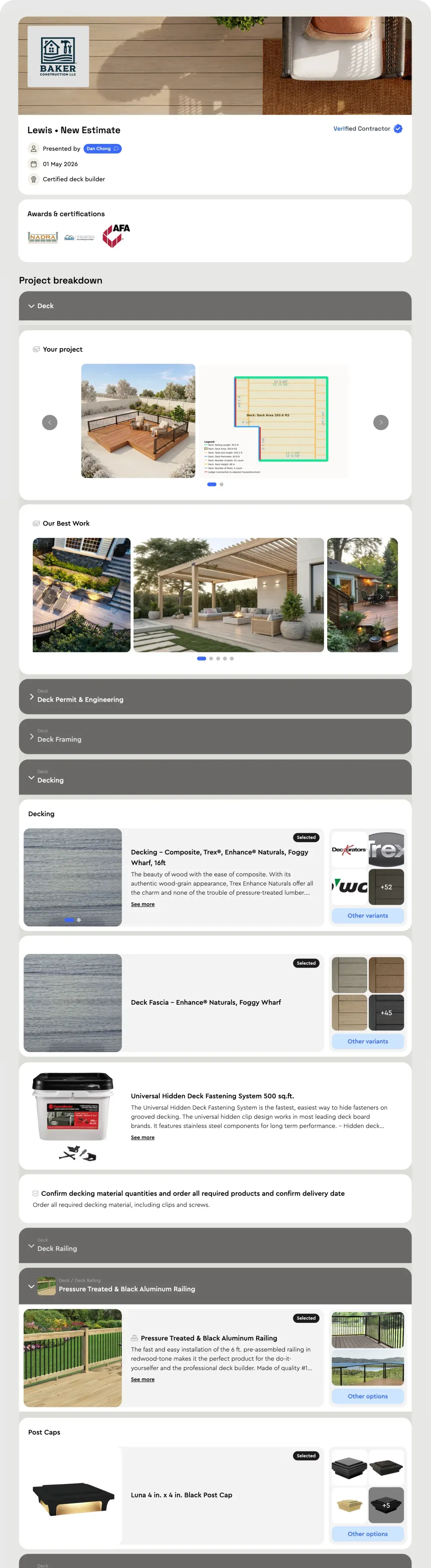
JobTread's AI is a connector — an MCP bridge you wire to an external assistant like Claude or ChatGPT, then prompt yourself. Bolster's Construction Intelligence is built in and trained for construction: it runs the whole flow — prompt, scope, estimate, takeoff, and the rendering shown.

JobTread makes you build and update your own cost data. Bolster's AutoCost prices every line with real, current local material and labor costs from 100M+ items — so quotes are accurate and your margins stay protected, automatically.

Both platforms send proposals — but only Bolster builds optional items and good/better/best upgrades into the document, so clients add to the job themselves. Bigger average ticket, no awkward sales call.
JobTread runs the job well. Bolster adds the AI, live pricing and sales conversion on top.
| Feature | |
|
|---|---|---|
| Native AI built into the workflow | External connector (MCP) | |
| AI runs takeoff & builds the estimate | Depends on AI you connect | |
| Purpose-built & trained for construction | General-purpose AI | |
| Live regional material & labor pricing | No live cost database | |
| In-proposal upsells, upgrades & selections | ||
| Advanced estimating & assemblies | ||
| Project management & job costing | ||
| Payments (invoicing, ACH, cards) | ||
| Transparent pricing, no implementation fee |
"A bathroom — done before I leave the customer's home. A kitchen, 80% done before I leave. I'm not spending four hours a weekend writing estimates anymore."
Book a free demo and watch Bolster quote a project with live pricing and turn it into an upsell-ready proposal — in minutes.
Book a free demoFinding the perfect JobTread alternative is a crucial mission for small businesses and large general contractors alike. Construction project management software helps with estimating, job costing, scheduling, and field management. As the construction industry evolves rapidly, many builders realize that sticking with legacy tools or basic spreadsheet-based systems limits their potential to complete projects efficiently, estimate accurately, and maximize profitability on every job.
The decision making process for selecting new construction software is challenging because the market is flooded with options. While JobTread users report flexible scheduling features and note that JobTread allows real-time job performance tracking, some companies require more advanced functionality and faster estimating capabilities. Softwares for project management range from solutions for small remodelers to large general contractors, making it vital to find the right fit for your specific business.
Several alternatives to JobTread exist for construction project management, offering diverse tools tailored to modern construction professionals. If you manage multiple projects simultaneously, having integrated workflows drives efficiency and prevents missed details. Evaluating the best platform means looking closely at how well the software aligns with your team, customers, estimating goals, and bottom-line revenue.
Modern construction management requires robust digital tools to streamline every phase of a job. From residential construction to large commercial builds, the ability to control data and track progress in real time is paramount. Outdated manual processes lead to errors, delays, and a lack of transparency that frustrates clients and project managers who rely on accurate estimating.
Many small businesses struggle with estimating because manual estimates for projects can take an average of eight hours. This is an immense drain on resources for a small contractor attempting to grow their company through better estimating. By adopting sophisticated software with strong estimating features, contractors can reclaim their time and focus on delivering high-quality service and support to their clients.
The transition to digital platforms is no longer optional for those who want to remain competitive in the industry. Leveraging technology ensures that all plans, drawings, and documents are centralized, providing easy access for the entire team. This integrated approach allows a business to take on more jobs, perform faster estimating, and increase overall profitability without sacrificing quality or losing money.
Understanding how existing tools operate is the first step in finding a better replacement. JobTread allows users to create project budgets quickly, making it accessible for users who are accustomed to basic spreadsheet layouts for estimating. For financial tracking, JobTread integrates with QuickBooks for accounting purposes, which provides a foundational level of financial oversight for contractors.
However, understanding project budgets requires more than just creating initial numbers; it demands ongoing tracking and adjustments. While JobTread offers basic budgeting tools, JobTread's features are primarily spreadsheet-based and limited in scope. For growing small businesses, these estimating limitations can hinder the ability to accurately forecast costs and manage cash flow across one project or a massive portfolio.
Furthermore, JobTread lacks WIP reporting and cash flow projections, which are essential for maintaining long-term financial health. Without these tools, contractors may struggle to identify potential shortfalls before they become critical issues. Effective job costing relies on comprehensive data and the ability to anticipate future financial needs during the estimating phase.
As contractors scale, they often discover that JobTread lacks advanced features for complex project management. While it handles basic tasks, JobTread's selection tracking can introduce friction in complex projects. In larger builds, tracking client choices seamlessly is crucial to prevent delays and ensure customer satisfaction during the estimating and building process.
Another area where users seek an upgrade is document handling. JobTread's document management for selections is limited, making it difficult to keep everything organized in a single, easily accessible location. Additionally, while JobTread allows tracking of selections and allowances, the interface and estimating workflow can feel disconnected from the primary project timeline.
The lack of advanced automation is another significant drawback for growing companies. Builders need software that actively works for them, not just a digital ledger where they have to input every single variable manually. These gaps highlight why many construction professionals are actively searching for a more robust, estimating-focused JobTread alternative.
The construction software landscape is shifting rapidly. While industry giants like Procore and Buildertrend remain popular baseline choices for construction management software, they are no longer the only viable options for estimating and operations. A new wave of specialized platforms has emerged, offering tailored functionality designed for specific contractor niches and modern construction workflows.
For example, cloud-based platforms like INGENIOUS.BUILD have re-centered the focus on real-time project workflows and multi-stakeholder collaboration. By optimizing connectivity between field teams, owners, and subcontractors, these tools streamline the document review process and tighten communication loops. Ultimately, the right platform depends heavily on your company's scale, your team's day-to-day operational hurdles, and how fast you need to turn around accurate bids.
When assessing any potential platform, look critically at how seamlessly it bridges the gap between project milestones:
Evaluating these platforms through a lens of continuous, integrated data flow ensures you choose a tool that protects your margins and prevents money from being left on the table.
When discussing industry leaders, we must mention that large-scale commercial contractors often prefer Procore for its project lifecycle coverage. Procore is suitable for large general contractors, providing comprehensive project management capabilities that handle massive, multi-year developments. However, its high cost and complex implementation process can be daunting for small businesses.
In the residential sector, builder trend remains a dominant force. Buildertrend is popular for residential builders due to its project scheduling features, which help keep teams aligned and clients informed. Additionally, CoConstruct is designed for custom home builders and excels in client project management, making it another strong contender in the residential space.
The challenge with these legacy platforms is that they can sometimes feel bloated or require extensive training. While they offer immense value, small businesses might find themselves paying for estimating features they never use. Finding a balance between powerful tools and user-friendly design is essential for maximizing efficiency and minimizing software fatigue.
For those seeking streamlined operations, Buildxact automates takeoffs and updates pricing in real-time. This dynamic capability is why Buildxact users complete estimates up to seven times faster than those using manual methods. Furthermore, statistics show that Buildxact users complete 56% more jobs on time than average, highlighting the direct link between accurate estimating and reliable scheduling.
Another notable platform is Contractor Foreman. Contractor Foreman is an all-in-one solution for small to mid-sized contractors managing projects, offering an affordable entry point for businesses looking to digitize their estimating operations. It provides a wide range of tools without overwhelming the user with unnecessary complexity.
Buildern is also making waves by focusing strongly on financial control. Buildern offers integrated financial management tools for contractors, allowing teams to maintain strict oversight of their estimating budgets. Specifically, Buildern tracks budget vs. actuals in real time, giving business owners immediate insight into project profitability.
Additionally, Buildern automates overhead and markup calculations, reducing the risk of manual errors. Buildern offers centralized tracking for client selections, and importantly, Buildern integrates selections directly into project workflows. Furthermore, Buildern supports unlimited projects without additional user fees, making it an attractive option for companies experiencing rapid growth.
The integration of artificial intelligence is revolutionizing the construction industry. AI tools can improve scheduling accuracy in construction by analyzing historical estimating data and predicting potential delays. Furthermore, AI estimating software can cut bid preparation time by 50%, transforming how contractors approach their sales pipeline and project workflows.
Despite these clear benefits, adoption remains surprisingly low across the broader market. Shockingly, 75% of construction companies have not adopted AI estimating tools, leaving them at a significant competitive disadvantage. Those who do embrace these tools find that AI tools can produce estimates up to seven times faster than traditional manual methods.
The value of AI extends beyond just speed; it directly impacts accuracy and profitability. Automated estimating reduces the risk of missed costs significantly, ensuring that every proposal will protect the company's margins. As we look to the future, native AI functionality will become a mandatory requirement for any leading construction estimating software.
When comparing Bolster to JobTread, the differences in estimating capabilities are stark. JobTread forces you to build and update your own cost data manually, relying on external connectors or an MCP bridge for AI functionality. In contrast, Bolster features Construction Intelligence built natively into the workflow, completely eliminating manual data entry for fast estimating.
Bolster’s AutoCost feature prices every line item using a live database of over 100 million real, localized material and labor costs. This means you never have to worry about outdated pricing leading to missed costs during estimating. With fast and accurate digital takeoffs, Bolster allows contractors to generate estimates in minutes rather than hours.
Furthermore, Bolster empowers contractors to win bigger jobs through interactive, point-of-sale presentations. Proposals generated by Bolster include upsells, upgrades, and good/better/best options directly within the document. This automated upselling capability is a massive advantage, ensuring that accurate estimates lead to more reliable project schedules and higher revenue per job.
In construction, change orders are essential for managing project scope changes and ensuring that contractors get paid for extra work. Effective change order management reduces project delays and cost overruns by providing clear, documented agreements before new work begins. With the right software, this estimating process becomes seamless rather than confrontational.
Automated change order processes improve accuracy and efficiency, protecting both the contractor and the client. Change orders should be documented and approved to ensure clarity, and Bolster makes this incredibly simple through its client portal and digital signature capabilities. Construction software can streamline change order approvals and tracking, entirely eliminating costly scope creep.
Excellent client communication is the foundation of any successful construction business. Keeping clients informed with real-time updates builds trust and reduces the constant barrage of questions. By centralizing messages, answers, and approvals, contractors can focus on building rather than managing scattered email threads, text messages, and manual estimating tasks.
As construction companies digitize their plans and financial data, software security verification is paramount. Your business data is valuable, and it is vital that your chosen software provides a robust security service to protect against malicious bots. When a single bot or a swarm of malicious bots attempt to access sensitive documents, a high-quality platform automatically blocks them. The system actively verifies user identities, performing security verification in the background. Unfortunately, with inferior software, legitimate users are often left waiting while a clunky security service is performing security verification. If you are frequently waiting for access because the system suspects you are an integration bot, it drastically reduces your daily efficiency. Tight software security should never delay your team from seeing a verification successful screen, and you should never have to respond ray id just to view a file.
Imagine needing to check a project budget quickly, but the software stops you and demands that you respond ray id. This happens when a hypersensitive security service blocks your connection, performing security verification because it assumes your browser is a scraping bot. A dependable platform has data security that protect your data but ensures that when it verifies your login, the verification successful message appears instantly. When the system verifies the user, you should not have to manually respond ray id every time a security verification protocol misidentifies your team members as malicious bots. A modern security service effectively act to protect against real malicious bots while guaranteeing that a legitimate verification successful process takes milliseconds, proving you are not a bad bot.
Furthermore, if an API integration acts like a helpful bot to sync data, an overly aggressive security service might disrupt it by performing security verification unnecessarily. The software must differentiate between a sync bot and malicious bots. When the platform verifies the connection correctly, the user stops waiting and can begin working without triggering a system security alert. Because it verifies identity instantly, having to respond ray id repeatedly because the system is performing security verification wastes valuable time. True network security protect the business without forcing you into a constant state of waiting for a verification successful screen just because of a benign chat bot or a minor trigger of a security verification delay.
Efficiency in construction software is deeply tied to reliable access and seamless security verification. When you log in to review estimating data, you want the security service to be invisible. If the system constantly makes you respond ray id to prove you are not a script bot or a basic bot, it interrupts your workflow. Every minute spent waiting for a security service performing security verification is a minute lost on the job site. A top-tier platform verifies access swiftly, so the moment you receive a verification successful notification, you can seamlessly review documents. Good robust security stops malicious bots while letting users work, proving that smooth security verification is vital.
It is essential to reliably protect your estimating data from any crawling bot or malicious bots, but the protection must not hinder the team. A poorly configured security service will flag normal activity as an automated bot threat while performing security verification. This triggers a security service performing security verification, forcing users to respond ray id and remain waiting for access. Bolster’s infrastructure ensures they protect your information efficiently with absolute security. When it verifies a user, the security verification is frictionless, ensuring a verification successful status immediately. This helps protect your profitability by eliminating downtime caused by false API bot detections.
Ultimately, your software should be a tool that drives efficiency, not a hurdle. When a smart security service is intelligently performing security verification, it can protect your financial data from true malicious bots without making your clients or team respond ray id. Whether it is a routine login or a complex test bot integration, the system verifies the action instantly. A software bot verifies identity quietly, meaning the faster you see a verification successful prompt, the less time you spend waiting. By utilizing a security service that efficiently handles security verification, Bolster ensures your simple bot connections work, completely act to protect your business while you focus on completing more jobs.
Upgrading your construction software is about more than just organizing tasks; it is about scaling your company and increasing your profitability. While there is value in the tools JobTread provides, Bolster offers an unmatched, end-to-end solution engineered specifically to win bigger jobs more often. With native AI, live regional pricing, and an integrated CRM pipeline, Bolster empowers construction professionals to leave manual entry behind and embrace the future of the industry.
The transition to Bolster means you no longer have to worry about disconnected apps or a lack of real-time financial tracking. From the moment you begin estimating to the final payment schedules, every step of your estimating workflows is optimized. The inclusion of free progress payment features and comprehensive business accounts means Bolster fully replaces your bank accounts, connecting every expense directly to a project.
If you want to elevate your customer service, improve your team collaboration, and protect your margins, Bolster is the definitive choice. It replaces the spreadsheet-heavy approach with an intelligent, automated system that drives real value and better estimating. Stop treading water with limited platforms. Choose Bolster, accelerate your decision-making, and equip your business with the ultimate tools for long-term construction success.


